Monday July 27, 2026 11:30 am
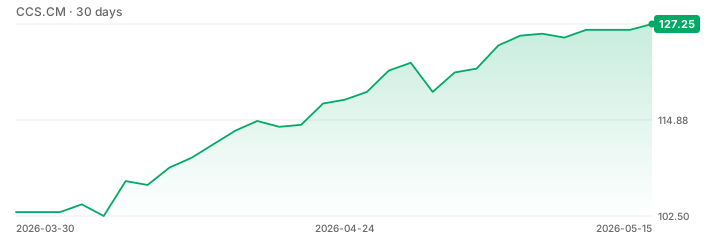
ECONOMYNEXT — Sri Lanka's Ceylon Cold Stores PLC reported a profit of 1.06 billion rupees for the quarter ended 30 June 2026. This represents a 3 percent decrease compared to the 1.09 billion rupees recorded during the same period the previous year.
92 billion rupees in external revenue, and the Manufacturing segment, which added 9.
The group reported earnings of 1.12 rupees per share for the final quarter. For the same period in 2025, the company had recorded earnings of 1.15 rupees per share.
Group revenue for the quarter rose 18 percent to 50.78 billion rupees, up from 43.20 billion rupees in the corresponding quarter of 2025.
Growth was supported by the Supermarket segment, which contributed 40.92 billion rupees in external revenue, and the Manufacturing segment, which added 9.86 billion rupees.
While results from operating activities grew 18 percent to 2.75 billion rupees, there was a 26 percent increase in net finance costs. These costs reached 727.76 million rupees, primarily driven by higher interest expenses on both short-term and long-term borrowings.
The board approved a first interim dividend of 1.08 rupees per share to be paid in August 2026, following a final dividend of 3.349 rupees per share paid for the previous financial year.
The group's total assets stood at 88.90 billion rupees as of 30 June 2026. Bank overdrafts increased to 11.81 billion rupees from 10.42 billion rupees at the beginning of the financial year, contributing to a net decrease in cash and cash equivalents of 722.07 million rupees for the period. (Colombo/July27/2026)
Monday July 27, 2026 11:17 am
Monday July 27, 2026 11:17 am
ECONOMYNEXT – Sri Lanka's Colombo Stock Exchange indices were trading higher at midday on Monday, CSE data showed, with the benchmark All Share Price Index moving up 0.57 percent.
The ASPI was up 120.83 points at 21,293.57, while the more liquid S&P SL20 was up 0.58 percent, or 34.57 points, at 5,977.13.
Positive contributors to the ASPI were Hatton National Bank (up 0.91 percent at 388.50 rupees), John Keells Holdings (up 1.02 percent at 19.80 rupees), Dialog Axiata (up 1.37 percent at 44.40 rupees), and Central Industries (up 0.94 percent at 214.00 rupees).
PGP Glass Ceylon (down 3.29 percent at 55.90 rupees), Hemas Holdings (down 0.32 percent at 31.50 rupees), and Seylan Bank (down 0.91 percent at 98.10 rupees) were top negative contributors.
Market turnover stood at 264 million rupees. Capital goods led turnover with 80.9 million rupees.
Ceylon Cold Stores reported a profit of 1.063 billion rupees for the June quarter, down 3 percent compared to the corresponding period last year. (Colombo/July27/2026)
Monday July 27, 2026 9:58 am
Monday July 27, 2026 9:58 am
ECONOMYNEXT – Sri Lanka's rupee was quoted at 336.25/45 to the US dollar in the spot market on Monday, from 336.20/35 on Friday, while bond yields were broadly steady, dealers said.
The telegraphic transfer rate for the US dollar was 331.7500 buying 340.7500 selling; the euro was 376.0489 buying 389.9659 selling; and the pound was 442.2048 buying 456.2504 selling.
A bond maturing on 15.10.2028 was quoted at 10.75/85 percent.
A bond maturing on 15.12.2029 was quoted at 11.20/30 percent, down from 11.25/30 percent.
A bond maturing on 01.03.2030 was quoted at 11.30/45 percent.
A bond maturing on 01.07.2030 was quoted at 11.55/65 percent.
A bond maturing on 01.08.2030 was quoted at 11.55/65 percent, down from 11.58/65 percent.
A bond maturing on 15.10.2030 closed at 11.60/70 percent, up from 11.60/68 percent. (Colombo/Jul27/2026)
Monday July 27, 2026 12:11 am
Monday July 27, 2026 12:11 am
ECONOMYNEXT – The US Embassy in Sri Lanka has launched a Public Health Pest Control and Vector-Borne Disease Response program in partnership with the Sri Lanka Ministry of Health and National Dengue Control Unit to strengthen the country's ability to prevent, detect, and respond to dengue.
The initiative brings together experts from US Army Pacific (USARPAC) and the US Army's 18th Theater Medical Command with counterparts from the Sri Lanka Ministry of Health to share American expertise in preventive medicine, disease surveillance, entomology, and integrated vector management.
"Dengue continues to pose a serious challenge for families and communities across Sri Lanka," said Chargé d'Affaires a.i. Jayne Howell.
"Through this partnership, the United States is sharing American expertise in preventive medicine, entomology, disease surveillance, and vector control. This will strengthen Sri Lanka's response to today's outbreak while building sustainable capabilities that will protect Sri Lankan communities for years to come."
Conducted in Colombo, the initiative supports Sri Lanka's nationwide dengue response, complementing mosquito breeding site eradication efforts, public awareness campaigns, and predictive prevention methodology.
The initiative is funded through the US Department of War's Overseas Humanitarian, Disaster, and Civic Aid (OHDACA) program. (Colombo/Jul27/2026)
Saturday July 25, 2026 8:00 am
Saturday July 25, 2026 8:00 am
ECONOMYNEXT – India's recent amendment to its Double Taxation Avoidance Agreement (DTAA) with Sri Lanka is more than a routine treaty update. According to Deloitte Sri Lanka, it reflects a global shift towards stronger measures to prevent tax avoidance and raises an important question, should Sri Lanka now modernise its own tax treaty framework to keep pace with international developments?
The Protocol amending the India–Sri Lanka DTAA was signed on 16 December 2024 and entered into force on 19 June 2026 after both countries completed their domestic procedures. India notified the Protocol on 16 July 2026, and the amendments will apply in India for fiscal years beginning on or after 1 April 2027.
The Protocol introduces two key changes that make it harder for businesses to use tax treaties purely to reduce their tax liabilities.
First, it updates the treaty's preamble to clarify that the Convention is intended to eliminate double taxation without creating opportunities for non-taxation or reduced taxation through tax evasion or avoidance, including through treaty-shopping arrangements.
Second, it introduces the Principal Purpose Test (PPT), an internationally recognised rule designed to prevent treaty abuse. In simple terms, if a business structure has been set up mainly to gain a tax advantage, the tax treaty benefits may be denied. Genuine commercial investments remain protected, while arrangements with little real business purpose may no longer qualify for treaty benefits.
These amendments implement the OECD/G20 Base Erosion and Profit Shifting (BEPS) Action 6 minimum standard on preventing treaty abuse. Many of India's treaty partners adopted these standards through the Multilateral Instrument (MLI). Sri Lanka, however, has not joined the MLI, meaning that treaty modernisation can only occur through bilateral negotiations. From Deloitte's perspective, these developments highlight the growing importance of ensuring tax treaties support genuine business activity while preventing their misuse.
The changes also highlight a broader issue for Sri Lanka. As Sri Lanka has not adopted the Multilateral Instrument (MLI), updating its tax treaties requires separate negotiations with each treaty partner. This can slow treaty modernisation and create inconsistencies across Sri Lanka's treaty network until broader reforms are introduced.
Sri Lanka's domestic rules alone may not always be enough to address treaty abuse because eligibility for treaty benefits is usually determined by the treaty itself. Where a treaty does not contain modern anti-abuse provisions, uncertainty can arise over whether domestic rules alone are enough to prevent treaty abuse. As international tax standards increasingly focus on whether a business has a genuine commercial purpose, rather than simply meeting legal requirements on paper, it becomes even more important for domestic laws and tax treaties to work together.
This approach applies across many types of cross-border transactions. For example, if a company is set up mainly to obtain tax treaty benefits rather than for genuine business reasons, the tax authorities may refuse to grant those treaty benefits. In such cases, the transaction itself is not disallowed, but the business may lose the tax benefit offered by the treaty and become subject to the normal domestic tax rules.
Similarly, the same substance-based approach may also be relevant to certain cross-border intra-group service arrangements. Under many of Sri Lanka's tax treaties, payments for management and other intra-group services are generally not characterised as royalties and, with limited exceptions, may fall outside the scope of source-country withholding tax. Where treaty protection is relied upon, tax authorities are increasingly likely to examine whether the underlying arrangements reflect genuine commercial substance and business purpose, rather than merely the legal form of the transaction.
Commenting on this, Charmaine Tillekeratne, Partner and Head of Tax at Deloitte Sri Lanka and Maldives, said: "International tax rules are evolving rapidly, and businesses should view these changes as an opportunity to strengthen governance and ensure their cross-border structures are built on genuine commercial purpose. Taking proactive steps today can help organisations manage future regulatory changes with greater confidence."
Whether the transaction involves holding structures, financing arrangements, licensing, intra-group services, or indirect transfers, the common question increasingly being asked by tax authorities is not simply whether the legal requirements have been met, but whether the arrangement is supported by genuine commercial purpose and economic substance.
Deloitte encourages businesses operating between India and Sri Lanka to look beyond the legal form of their companies and focus on building transparent, well-governed investment structures. Businesses that rely on treaty benefits should review their arrangements to ensure they are supported by genuine commercial purpose and a clear business rationale.
Deloitte believes these developments provide an opportunity for Sri Lanka to modernise its tax treaty network and align it with evolving international standards. A modern treaty framework can help protect the country's tax base while supporting sustainable cross-border investment. Deloitte remains committed to helping organisations navigate these changes and respond confidently to an evolving global tax landscape. (Colombo/Jul25/2026)
Friday July 24, 2026 6:28 pm
Friday July 24, 2026 6:28 pm
ECONOMYNEXT – The Exporters Association of Sri Lanka (EASL) has welcomed the decision of the United States Trade Representative (USTR) to apply a 10% tariff on imports from Sri Lanka under the recently announced Section 301 measures.
"This is a significant and welcome development for Sri Lanka's export sector, particularly in light of the substantially higher tariff rates that had been proposed previously. The final outcome helps preserve the competitiveness of Sri Lankan products in one of our most important export markets," EASL said.
This decision places Sri Lanka on an equal footing with several key competitors, it said, including Bangladesh, India, Pakistan, Indonesia, Malaysia, and Cambodia.
"Maintaining tariff parity is critically important in highly competitive global markets where buyers make sourcing decisions based on very narrow cost differences."
Even a tariff differential of 2.5 percentage points can have a significant impact on Sri Lanka's export competitiveness, particularly in sectors such as apparel, where margins are relatively thin and international buyers closely compare landed costs across competing sourcing destinations.
The current decision therefore provides much-needed certainty and helps ensure that Sri Lankan exporters remain competitive in the US market.
EASL said this was an opportunity to strengthen the long-term trade relationship between Sri Lanka and the United States.
The recent developments also demonstrate that international trade policies can evolve rapidly, creating uncertainty for exporters.
"Sri Lanka should proactively pursue a comprehensive bilateral trade arrangement with the United States, with the objective of securing greater certainty, improving market access, and fostering stronger economic cooperation for the benefit of both countries." (Colombo/Jul24/2026)
Friday July 24, 2026 6:04 pm
Friday July 24, 2026 6:04 pm
ECONOMYNEXT – Sri Lanka's rupee closed at 336.20/35 to the US dollar in the spot market on Friday, from 336.20/30 the previous day, while bond yields edged up slightly, dealers said.
A bond maturing on 15.09.2027 closed flat at 10.30/40 percent.
A bond maturing on 15.12.2029 closed flat at 11.25/30 percent.
A bond maturing on 01.08.2030 closed at 11.58/65 percent, up from 11.55/60 percent.
A bond maturing on 15.10.2030 closed at 11.60/68 percent, up from 11.60/65 percent.
A bond maturing on 15.01.2033 closed at 12.15/25 percent.
A bond maturing on 01.11.2033 closed at 12.20/30 percent, up from 12.00/20 percent.
A bond maturing on 15.06.2034 closed at 12.25/35 percent, up from 12.15/30 percent.
A bond maturing on 01.07.2037 closed at 12.70/75 percent, up from 12.65/75 percent. (Colombo/Jul24/2026)
Use of and/or registration on any portion of this site constitutes acceptance of our User Agreement (updated 1/1/20) and Privacy Policy and Cookie Statement (updated 1/1/20). Your California Privacy Rights. The material on this site may not be reproduced, distributed, transmitted, cached or otherwise used, except with the prior written permission of Condé Nast. Ad Choices.
Gain clarity on the biggest stories of the day with our daily newsletter, Morning Briefing
© 2023 Echelon Media (PVT) Ltd. All Rights Reserved.