Chinese scientists have developed a new neuromorphic chip capable of modeling complex brain structures in real time, with developers claiming performance up to 478 times faster than Nvidia’s A100 GPU.
The chip integrates data storage and computation within a single memory array, a design intended to accelerate diagnostics and treatment for neurological conditions while reducing energy consumption compared to traditional architectures.
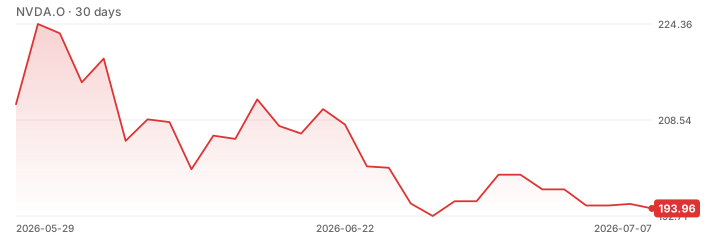
The announcement arrives as Nvidia’s dominance in the Chinese artificial intelligence chip market faces its most significant challenge yet.
Sales of the US giant’s advanced processors have stalled amid rising competition from domestic manufacturers and ongoing export restrictions.
This latest development from Chinese researchers highlights the accelerating pace of local innovation aimed at reducing reliance on foreign semiconductor technology.
While the chip’s primary focus appears to be on specialized biomedical applications rather than general-purpose data center workloads, the underlying technology could have broader implications for the semiconductor sector.