The International Monetary Fund has issued a stark warning that the global oil market’s ability to absorb supply shocks from the Strait of Hormuz has effectively vanished.
The IMF states that the inventory buffers which previously shielded prices from volatility are now dangerously low, leaving the market exposed to immediate repricing if tensions in the region escalate further.
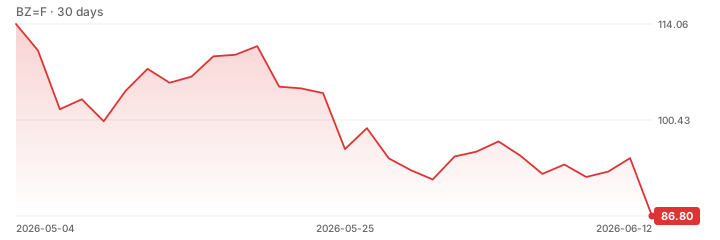
The warning comes as geopolitical uncertainty continues to cap the downside for Brent crude, which has stabilized around $72 in recent sessions.
This assessment marks a significant shift in the risk profile for energy traders.
While global markets have demonstrated resilience in the face of recent West Asian conflicts, largely dismissing earlier escalations as transient events, the depletion of strategic reserves removes the primary shock absorber.
The IMF’s analysis suggests that the market is no longer in a position to weather a sustained disruption without a sharp reaction in crude prices.
The warning comes as geopolitical uncertainty continues to cap the downside for Brent crude, which has stabilized around $72 in recent sessions. However, the absence of a buffer means that any new threat to tanker routes or shipping lanes could quickly reverse this stability.
The IMF’s caution underscores the fragility of the current equilibrium, where price stability is maintained not by ample supply, but by the absence of a major new shock.