BANK of the Philippine Islands (BPI) expects its profit growth to rebound this semester, supported by the sustained expansion of its corporate loan book to offset pressures faced by its consumer and small business lending segments.
"Typically, in any given year, we tend to see the second half perform a little better than the first half. And so, we think there's good reason for us to expect that we can see a little better performance in the second half versus, effectively, the annualized second quarter. But of course, most of the first quarter was before the Middle East conflict, and so that in a sense disrupts a little of what we might see in terms of a regular historical pattern," BPI Chief Financial Of f icer Eric M. Luchangco said at a media briefing on Monday.
" Mr. Gasmen added that BPI will likely maintain its 85% to 15% local-to-foreign-currency funding mix.
"But I think it's reasonable for us to think that we could see a similar performance or slightly higher performance in the second half versus the first half of this year."
BPI's net income slipped by 0.4% year on year in the first half to P32.8 billion as increased expenses and loan-loss provisioning offset strong revenues from its core businesses, it reported last month.
The bank's provisioning could be steady for the rest of the year on hopes that market volatility would subside and economic conditions improve, the official said.
"If it stays the same, then there's going to be no more additional costs for macroeconomic conditions. If it improves, we might actually see a return on some of those provisions. But I guess it's a bit of a long way of saying that we don't expect the second quarter to be representative of what the rest of the year should be," Mr. Luchangco said.
For its corporate loan book, BPI Senior Vice-President and Head of Institutional Banking Luis Geminiano E. Cruz said the bank expects growth to stay steady at 8%-10% growth for the rest of the year despite expectations of weaker demand as corporates shift to spending their working capital rather than borrowing.
"What we are monitoring now is really the utilization of working capital. Even where the rates are, you can see that some companies are trying to use the existing cash flow versus lending… We can see the balancing of costs and the impact of the situation where they are in now."
Still, he said they expect steady loan growth as companies still have projects in their pipeline that need financing.
The bank is also looking at growth opportunities in real estate, particularly outside the National Capital Region (NCR), as well as power.
On the consumer end, BPI Head of Consumer Banking and Executive Vice-President Maria Cristina "Ginbee" L. Go said they have seen a shift to essential spending from discretionary spending in their credit card line, while housing sales have contracted.
"But we've seen certain spots or reshoots in our housing business, particularly in the secondary market where people have seen good bargains," she added.
BPI also sees growth opportunities in construction, solar, and mortgage loans, as well as electric vehicle loans as consumers adjust to rising oil prices.
"I think what we will focus on in the next half of the year is really to make sure that we're able to underwrite more responsibly and to provide the needed credit to those with concerns," she added.
For loans to small businesses, BPI Head of Business Banking Dominique R. Ocliasa said they expect moderate growth as the sector has been hit hard by the weakening economic environment.
"In the last 12 months, this segment has really been challenged by macroeconomic conditions and political issues. These have beset the growth potentials of our SMEs (small and medium enterprises). In the last six months or so, we've had some stress in the book. But this has forced us to take stock of the way we do credit, our underwriting processes, as well as our origination processes. And the immediate task is to be able to stabilize the stress of the book," Mr. Ocliasa said.
"In fact, on top of our organic collectors, we're now starting to increasingly outsource to help out in the collection efforts. Once that gets stable, we'll start turning to expansion mode once again."
He said the segment's nonperforming loan (NPL) ratio has climbed to around 12% from 7%-8% last year, with construction and non-essentials including retail being the most affected sectors.
"In the third quarter, immediately following the chilling effect of the flood control mess, we noticed that the construction companies that were affected were the smaller ones. And then, as this lingered during the first quarter going to the second quarter of this year, construction exposures continued to increase. It was starting to affect even the bigger ones."
Meanwhile, BPI's wealth arm is expected to grow its assets under management by 15%-20% this year after reaching P1.95 trillion as of March and becoming the largest trust entity in the country, BPI Wealth President Maria Theresa D. Marcial said.
She said they will push for products related to the Personal Equity and Retirement Account as they look to address the country's retirement savings gap via partnerships with corporates and employers.
FUNDRAISING Meanwhile, BPI Treasurer and Global Markets head Dino R. Gasmen said there is room for another peso-denominated bond issuance this year to refinance its P40-billion SINAG or Supporting Inclusion, Nature, and Growth bonds maturing in December. "I'm sure the bank is going to refinance that with another peso bond."
The bank last tapped the domestic market earlier this year, raising P50 billion from its two-year Supporting Individuals Grow, Lead, and Achieve or SIGLA Bonds.
However, they are unlikely to tap the offshore bond market again this year even with its $250-million green bond with the International Finance Corp. set to mature this month due to this issue's size and unfavorable market conditions.
"The bank has liquidity anyway in dollars, so we don't need to hurry. We don't want to rush into a market that's kind of volatile at the moment. So, I think the bank will wait a bit before refinancing it. I think the bank also wants to see whether there's a need to fully refinance it. It depends really on the pipeline for dollar-denominated loans. It depends if we can use the dollars or not," Mr. Gasmen said.
"You can refinance it through the issuance of another bond, but you know, $250 million is too small for the US market. It has to be at least $300 million to make it meaningful, or $500 million. I don't think we're going to use the dollars. We'll probably scale it down, but not do it through a bond. Probably a bilateral loan or a syndicated loan. There are a lot of alternatives for BPI with regard to refinancing the bond."
Mr. Gasmen added that BPI will likely maintain its 85% to 15% local-to-foreign-currency funding mix.
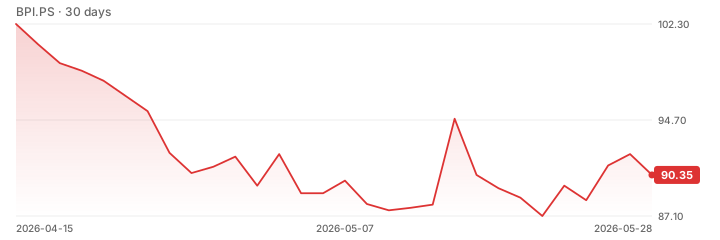
BPI shares rose by P2.30 or 2.24% to close at P104.80 apiece on Monday. — Aaron Michael C. Sy.